How to Download to a Flash Drive on a Mac
How to create a bootable installer for macOS
You tin can employ an external drive or secondary volume as a startup disk from which to install the Mac operating system.
These advanced steps are primarily for system administrators and others who are familiar with the control line. You don't demand a bootable installer to upgrade macOS or reinstall macOS, merely information technology tin exist useful when you want to install on multiple computers without downloading the installer each fourth dimension.
What you demand to create a bootable installer
- A USB flash drive or other secondary volume formatted as Mac Os Extended, with at to the lowest degree 14GB of available storage
- A downloaded installer for macOS Monterey, Big Sur, Catalina, Mojave, Loftier Sierra, or El Capitan
Download macOS
The installer for macOS Monterey,macOS Big Sur,macOS Catalina,macOS Mojave, ormacOS High Sierra downloads to your Applications binder every bit an app named Install macOS [version name]. If the installer opens subsequently downloading, quit it without continuing installation. To get the right installer:
- Download on a Mac that is compatible with that version of macOS.
- Download on a Mac that is using macOS Sierra 10.12.5 or afterwards, or Bone X El Capitan 10.11.6.
- Enterprise administrators: Download from Apple, not a locally hosted software-update server.
The installer for OS X El Capitan downloads to your Downloads binder equally a deejay image named InstallMacOSX.dmg. To go the installer:
- Download using Safari, and open up the disk image on a Mac that is uniform with Bone X El Capitan.
- Inside the disk image is an installer named InstallMacOSX.pkg. Information technology installs an app named Install OS X El Capitan into your Applications folder. You will create the bootable installer from this app, not from the deejay image or .pkg installer.
Use the 'createinstallmedia' command in Terminal
- Connect the USB wink drive or other volume that you're using for the bootable installer.
- Open Terminal, which is in the Utilities folder of your Applications folder.
- Type or paste one of the post-obit commands in Terminal. These assume that the installer is in your Applications folder, and MyVolume is the name of the USB flash bulldoze or other book you're using. If it has a different name, replace
MyVolumein these commands with the proper noun of your volume.
Monterey:*
sudo /Applications/Install\ macOS\ Monterey.app/Contents/Resources/createinstallmedia --volume /Volumes/MyVolume
Big Sur:*
sudo /Applications/Install\ macOS\ Big\ Sur.app/Contents/Resources/createinstallmedia --book /Volumes/MyVolume
Catalina:*
sudo /Applications/Install\ macOS\ Catalina.app/Contents/Resource/createinstallmedia --volume /Volumes/MyVolume
Mojave:*
sudo /Applications/Install\ macOS\ Mojave.app/Contents/Resources/createinstallmedia --volume /Volumes/MyVolume
High Sierra:*
sudo /Applications/Install\ macOS\ High\ Sierra.app/Contents/Resource/createinstallmedia --volume /Volumes/MyVolume
El Capitan:
sudo /Applications/Install\ Bone\ X\ El\ Capitan.app/Contents/Resource/createinstallmedia --book /Volumes/MyVolume --applicationpath /Applications/Install\ OS\ X\ El\ Capitan.app
* If your Mac is using macOS Sierra or earlier, include the--applicationpath argument and installer path, like to the way this is done in the command for El Capitan.
Later typing the command:
- Press Return to enter the control.
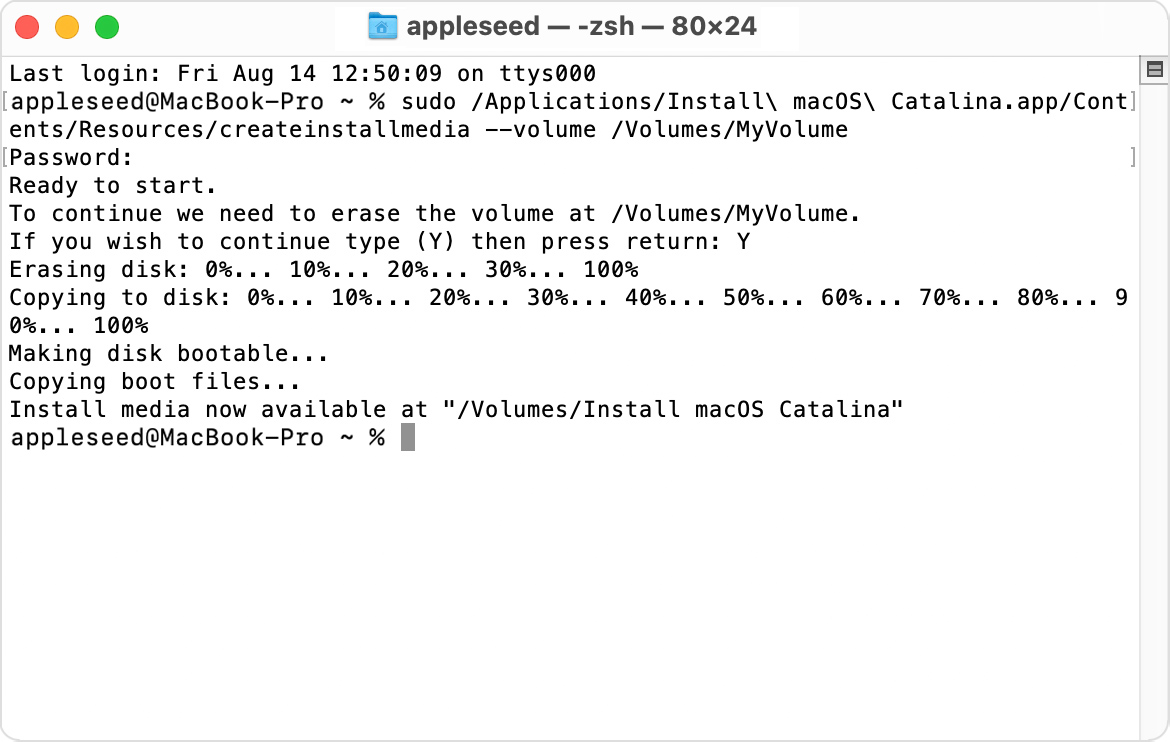
- When prompted, type your administrator password and press Render over again. Concluding doesn't testify any characters as you blazon your password.
- When prompted, type
Yto confirm that you want to erase the volume, and then press Render. Last shows the progress equally the book is erased. - After the book is erased, you may run into an alert that Final would similar to access files on a removable volume. Click OK to let the copy to proceed.
- When Terminal says that information technology's done, the volume volition accept the same name as the installer y'all downloaded, such as Install macOS Monterey. You lot can now quit Terminal and eject the volume.
Use the bootable installer
Apple tree silicon
- Plug the bootable installer into a Mac that is continued to the internet and compatible with the version of macOS you're installing.
- The macOS version that came with the Mac is the earliest version it tin use.
- A bootable installer doesn't download macOS from the internet, but it does crave an net connection to get firmware and other information specific to the Mac model.
- Plough on the Mac and continue to hold the power button until you lot encounter the startup options window, which shows your bootable volumes.
- Select the volume containing the bootable installer, then click Continue.
- When the macOS installer opens, follow the onscreen instructions.
Intel processor
- Plug the bootable installer into a Mac that is continued to the internet and compatible with the version of macOS you're installing.
- The macOS version that came with the Mac is the primeval version information technology tin can use.
- A bootable installer doesn't download macOS from the internet, just it does require an net connection to go firmware and other information specific to the Mac model.
- Press and hold the Option (Alt) ⌥ primal immediately after turning on or restarting the Mac.
- Release the Selection central when you see a dark screen showing your bootable volumes.
- Select the volume containing the bootable installer. Then click the up arrow or press Return.
If you tin't offset up from the bootable installer, make certain that Startup Security Utility is set to permit booting from external or removable media. - Choose your language, if prompted.
- Select Install macOS (or Install Os X) from the Utilities window, then click Continue and follow the onscreen instructions.
Larn more
For information well-nigh the createinstallmedia command and the arguments y'all can utilise with it, make sure that the macOS installer is in your Applications folder, then enter the appropriate path in Terminal:
/Applications/Install\ macOS\ Monterey.app/Contents/Resources/createinstallmedia
/Applications/Install\ macOS\ Large\ Sur.app/Contents/Resources/createinstallmedia
/Applications/Install\ macOS\ Catalina.app/Contents/Resources/createinstallmedia
/Applications/Install\ macOS\ Mojave.app/Contents/Resources/createinstallmedia
/Applications/Install\ macOS\ High\ Sierra.app/Contents/Resources/createinstallmedia
/Applications/Install\ Os\ X\ El\ Capitan.app/Contents/Resources/createinstallmedia
Published Engagement:
How to Download to a Flash Drive on a Mac
Posted by: shealeygrarnices.blogspot.com